Showing posts with label passions. Show all posts

Saturday, November 14, 2009

THE TEN COMMANDMENTS FOR TEACHERS

Over at A Difference by Darren Kuropatwa there was discussion that was similar to my recent post of Learning Now. At least it reminded me of that post.  
Darren talks about reading George Polya’s 10 Commandments for Teachers and how that has affected his teaching. 
THE TEN COMMANDMENTS FOR TEACHERS
In chapter 14 of Mathematical Discovery Polya lists his Ten Commandments For Teachers. They have been a guiding light for me as a teacher since I first read them.
1. Be interested in your subject.
2. Know your subject.
3. Know about the ways of learning: The best way to learn anything is to discover it by yourself.
4. Try to read the faces of your students, try to see their expectations and difficulties, put yourself in their place.
5. Give them not only information, but "know-how," attitudes of mind, the habit of methodical work.
6. Let them learn guessing.
7. Let them learn proving.
8. Look out for such features of the problem at hand as may be useful in solving the problems to come — try to disclose the general pattern that lies behind the present concrete situation.
9. Do not give away your whole secret at once — let the students guess before you tell it — let them find out by themselves as much as is feasible.
10. Suggest it, do not force it down their throats.
Darren continues
Polya identifies the single most powerful and infallible teaching method: "If the teacher is bored by what he is teaching it is a certainty that all his students will be too." I believe the inverse is also true: If a teacher is interested in what they are teaching their students will be too. Actually, "interest" by itself may not be enough; passion is a virus. There is a contagion in passion that can be passed on. I would rewrite Polya's first commandment as: "Be passionate about your subject." If you can't do that then I guess interest will have to do but if you don't have even that, do something else.
Passion for teaching is very important. Passion for learning is very important. Teachers must show a passion for what they are teaching. 

When students see that teachers are passionate about their subject, passionate about learning, then the students will see a reason to learn.

Teachers who are passionate about learning do not always get every page of the curriculum finished, but their students can carry on the learning on their own, for the rest of their lives.

Rather than making good marks on a true-false/multiple choice test at the end of each grade, students progress should be measured by how well they know how to learn, how well they can compete for the job that they have a passion for, how well they can convey that passion to their customers when they have that job.  These are true measures of learning and value.  We are not trying to prepare our students of the 21st century to be able to spout facts verbatim when asked.  We are preparing them for their futures, their lives, their livelihoods. 

If we, as teachers, can ignite a passion in our students to learn, to know how to learn, to know when it is necessary to learn more, we have succeeded as teachers, no matter what the test scores say.
How do you show
your passion for life,
for learning, and for teaching
so that your students know
its importance
in their own lives?
[As always, in my author quotes, the underlines, color changes, and bold type is mine, not the author’s!]

Thursday, August 13, 2009

FREE in a digital society… How does one earn money?

I have been wondering this same thing for many days, weeks, months. 

In a FREE digital society, how does one earn money?

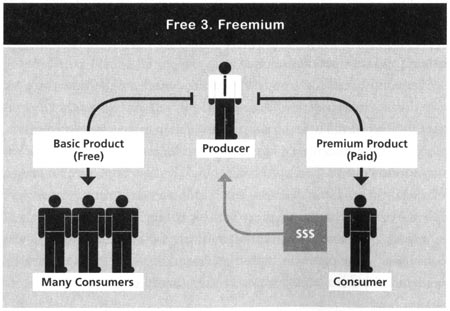
I heard about the figure and description (below) in a blog written by Kevin Kelly.  He has an uberblog combining all of his blogs together, but this is from his blog called Cool Tools.

The figure and quote below is from a book written by Chris Anderson, Free- The Future of a Radical Price.

[As always, the underlines, color changes, and bold type is mine, not the author’s.  I do this so often, I should probably put a disclaimer to this effect at the bottom of every blog!]

free-ex1.jpg

Chris Anderson says in Free- The Future of a Radical Price, “In Denmark, a gym offers a membership program where you pay nothing as long as you show up at least once a week. But miss a week and you have to pay full price for the month. The psychology is brilliant. When you go every week, you feel great about yourself and the gym. But eventually you'll get busy and miss a week. You'll pay, but you'll blame yourself alone. Unlike the usual situation where you pay for a gym you're not going to, your instinct is not to cancel your membership; instead it's to redouble your commitment.”

Kevin Kelly of Cool Tools blog says, “Free is tricky. Free is great for consumers but difficult for business and creators. It is becoming a serious economic force (thanks to digital technologies and automation) but no one is really sure how to use free to, well, make money.”

This reminds me of a situation I recently found myself in. 

I read many blogs. I enjoy reading them.  I read from a variety of blogs, although most of them have an education/technology bias.  One blog that is not in that category is about Marriage.  It is a good blog with lots of ideas and helpful comments, stimulating ideas!

Recently I read this Marriage blog and just about deleted it from my Reader.  I was furious! 

I even wrote a comment! I hardly ever, almost never, make a comment.  I might write about what I read in other people’s blogs in my blog, as a way to take the thoughts through my mind for processing.  I might occasionally say, “Hey, good blog!” but rarely do I make a negative comment.  Actually, I think this was the first!

This blog asked for readers to make a donation if they felt the blog was helpful. Say $25. Say only this year while I am trying to make my change from earning a living elsewhere to earning it with this blog. Say maybe only once every year!

So far, in the comments of others, only 1 other person agreed with me

Everyone else said,

“Good Luck with the change.” 

“Hope this leap of faith works out for you!” 

“When I can, I will send you money, but just can’t now, not today!”

I would like to know what others feel about this.

Do you expect to be solicited by the author of the blogs you read?

I am not talking about a blog author who wrote a book and promotes it on his blog, or who provides seminars or presentations and promotes them on his blog, or offers to consult with you privately about what he can do for you personally on his blog.  All of these are legitimate to me.   If you want that extra special piece of attention/help, PAY FOR IT!  That is fine. It is OK to advertise for that. Those interested will click on your link!  Those not interested, will just continue reading. 

If you don’t want your blog to be free and open, then don’t put it on the open internet. Make it by registration only after a fee has been paid!

Am I too upset by this?

Recently, I even looked at the tab on Blogger where it says monetize.  I didn’t go very far, but wondered if this was the “way” to earn my living on the web! 

I know several of the blogs I read do place ads on their blogs, and earn some small amount of money when readers click on these advertisements. 

I don’t criticize those who do this. (I am not sure, but I don’t think they earn very much by doing this; maybe only enough to pay for the yearly cost of the site maintenance if their blog is posted on a paying site.)

So far, I decided it was not for me.  I didn’t feel that my blog had a big enough readership (if any readership) and I didn’t feel that my thoughts were earth shattering. Most of what I post is a re-thinking of what I have read in other places - a directing of others to a good read.

In spite of all this, I do have a desire to make a living in a way that feeds my passions – education, technology, helping others, working with students, education, learning. 

I had also thought that somehow I could make this living with my passions on the internet, but in education nearly everything is open source, free. 

I’m still reading, thinking, learning, and imagining. Maybe someday, I will figure it all out.  In the meantime, I am enjoying the journey! (But not making any money!)