Showing posts with label education. Show all posts

Saturday, February 4, 2012

PHOTO PEACH

A fun site to use - Photo Peach (for educators - free).
I found it by following another teacher blog
that had a great slide show
to help students learn
the differences between circles and spheres.

I signed up quickly, downloaded a few pictures
and immediately made a slideshow.
I would like to spend more time with it.

How would you use this site?

Sunday, January 22, 2012

Cartoonize a Photo

Cartoonize


This one is FUN,
and VERY EASY!

Just take any photo
that you already have
and press a button..
BINGO!
Your photo is cartoonized!


I started with a photo
of my two daughters with me
at the older daughter's wedding
on 11-11-11 @11 PM!


Then just for fun,
I did another one of the Bride.


Notice this bride photo didn't change as much.

How would you use this 
with your students 
for educational purposes?

Create a COMIC Strip


Write Comics

This one is a little bit harder
to get going.
As you can see from my sample,
if you look closely
on the left of the 2nd screen
I did NOT get the old man
moved over to the right
before I saved it.
So spend some time with this.

Once again...
Fun for the students, but...
How would you use this
in your classroom for education?

Playing with Animation Programs

This is a fun animation Program.
ODD CAST.com

This is the photo I started with:

First take any photo you already have.
Then you can adjust the area that you want to show
 - mostly your face.
There are lots of options to change.
It's free and the students will love it.
I can't wait to show it to them.

How would you use this program 
for education purposes?

This is the animation I ended up with:


Oddcast Powered

Sunday, August 22, 2010

Passwords are like underwear…

From Taste of Tech by John Schinker blog post called What’s the Password…

When talking about passwords, I’m reminded of the adage that passwords are like underwear:

    • change them often
    • don’t share them with friends
    • the longer, the better
    • don’t leave them out where people can see them.

…here are a few tips for improving your password:

    • Don’t use your name, or the names of your spouse, children, or pets. Those are just too easy to guess.
    • Stay away from words that can be found in the dictionary. It’s pretty easy to do a “dictionary attack,” where hackers try all of the words and word combinations to try to get your password.
    • Mix upper- and lower-case. For the average password, changing some letters to upper-case will make the password 200 times harder to crack.
    • Use all of the characters. There are 102 keys on your keyboard, but only 26 letters. It’s okay to use punctuation, numbers, and even spaces in passwords. Throwing in some of these characters will make your password another 100 times harder to guess.
    • Use different passwords for different things. Our student records system uses different usernames and passwords from our network and email systems. In this case, that was very good. Whoever got access to these teachers’ accounts couldn’t access grades or attendance information.
    • Protect your email. Your email password is probably the most important one. Why? What happens when you go to an online site and you click the “I forgot my password” link? They email you a link that you can click on to reset your password. If someone has your email password, they can reset your passwords for many of the online services you use. So your Facebook / Twitter / Youtube / Flickr accounts might be in jeopardy if your email password is compromised.
    • Change your passwords. Certainly not every day. Probably not even every month. But once in a while, change your password. This is especially true if you school IT person just strongly suggested that you do so (hint, hint).

This is excellent advice for everyone.  We do all have many different user names and passwords. It gets very complicated to have so many and to change them all the time, but it is a necessary evil.

What advice do you have about passwords?

Do you have a Horror Story about passwords and hacking into user accounts?

How did you solve it?

Where Do You Live?

Do you live in the real world? the world of your students? in the World of Technology?

I just read the blog post of Shelley Terrell at Teacher Boot Camp where she posts this quote:

“For teachers who spend time there, blog-tweet world is like King Solomon’s Mines, full of riches and constantly replenished with new ideas and links. But most teachers don’t live there. This is sad perhaps, but it’s the truth.” by Ken Wilson

From Shelly’s blog post, she states …

No, I do not believe teachers who do not use technology are bad teachers, but this is what I believe….

    • If we are knowledge sharers, shouldn’t we continue to fill ourselves with knowledge?
    • If we want to inspire students to continue learning throughout their lives, then shouldn’t we continue to learn throughout our lives?
    • If we want motivated students who see learning as a journey, then shouldn’t we continue our journey?
    • If we want to motivate students to be the best in their fields, then shouldn’t we be the best in our fields?
    • If we want other educators to listen to our ideas, then shouldn’t we read about their ideas?
    • If we want support from our colleagues, then shouldn’t we support their workshops and projects?
    • If we want students to use digital media responsibly, then shouldn’t we give them access and show them how?
    • If we want students to not let technology overtake their lives, then shouldn’t we teach them how to balance themselves?
    • How can we teach balance, if we don’t have any social media in our diet?

Do you live anywhere near the world your students live in?  (digitally?)

Are you willing to move closer to their world or at least visit their world to get a glimpse of it?

Tell me where you live and where you are willing to live?

Information Overload

Eric Schmidt, CEO of Google summed up our new world perfectly  last week:

We create as much information in two days now as we did from the dawn of man through 2003.

I, too, like everyone in this day and age, am overloaded with information. It is the start of a new school year with a new job description… an exciting prospect, but nevertheless, lots of new information for me and from me needs to be out there.

How do you cope with all the information that is out there, that you must learn or know about, and that you must disseminate to others?

Let me know.

Image from  http://www.pamil-visions.net/wp-content/uploads/2009/08/information-overload-cartoon.jpg

Friday, July 2, 2010

The Miracle is You…

You really need to watch this excellent video…

I found this video on Ashley Tan’s blog.

It is amazing what can be done these days.  As Ashley says…

What do you get when you combine biology with music, art and digital story telling?

This video…

Students will learn more and remember more when they get to put facts into their own generation’s style.

How do you allow your students to show their own learning styles along with their knowledge and understanding of the facts? Leave a comment.

Tuesday, June 29, 2010

Please, I don’t want to hear that.. I’m so glad it’s summer today!

Thanks again to blogger friend Pat H. from Successful Teaching who has hit upon another favorite blog post she relayed to me! 

(I have to admit, I had been WAY behind in reading my blogs and my recommended postings from fellow bloggers, but … WOW, Pat, you sure are hitting the nail on the head with me this month!)

Please mosey on over to Top 9 phrases teachers hate to hear. from The Chronicles of a Veteran Kindergarten Teacher by Cheeseboy, to read the details. Most of you can imagine the descriptions from just these sub titles.

I present to you, in full Cheeseboy regalia, the top 9 announcements teacher hate to hear:
9. "The PTA will be putting on a fund-raising assembly today."

8. "Today will be an inside recess day."

7. "It's Grandparents Day today!"

6. "The 6th (or any other grade) is using the gym today."

5. "The choices for lunch today are trout treasures or chili."

4. "It won't stop bleeding."

3. "I kicked my shoe over the fence at recess."

2. "Tomorrow is crazy hair day."

1. "I couldn't make it to the bathroom."

ENJOY!

What do you do to have fun rather than tear your hair out at the end of a BAD HAIR DAY at school? Leave a comment.

Digital Footprints… What do you know?

Parents, students, teachers, EVERYONE should watch this video and discuss it!

Video compliments of …

Educational leaders in Hoover, Alabama, have created a superb "teaser" video for upcoming parent education classes on digital citizenship which will begin this fall. The 3 minute, 35 second video includes well-planned scenes depicting the choices as well as consequences involved with cell phone sexting.

Students of today need to understand their digital footprint and know what and how it impacts them, their lives, their future.

Thanks again to blogger friend Pat H. from Successful Teaching. who alerted me to this blog post Digital Citizenship video resources from Hoover, Alabama Schools and Common Sense Media from Moving @ Speed of Creativity by Wesley Fryer, one of my PLN bloggers that I read.

How are you teaching and guiding the students/children you are responsible for regarding their digital footprint? Leave a comment.

[As always, in my author quotes, the underlines, color changes, and bold type is mine, not the author’s!]

Learning should come from within…

I read a blog post suggested to me by fellow blogger friend Pat H. from Successful Teaching.The blog post, Reversing the Curriculum, was from the blog entitled Special Ed Changes.

The blogger got my interest immediately and I desperately wanted to share the first 2 videos with my readers.

I know I should keep on with my narrative here and make my point, but I don’t want to make you wait longer in your reading to see these two entertaining videos. When you finish them, we will continue with our narrative. (I’m just like a 5 year old!)

Here are those 2 videos.

and the 2nd video …

Watching these 2 engaging videos made me realize that it would be great if children could learn what they wanted, when they were ready, when they wanted, and in the order they wanted, much like the Montessori Method.

View this Montessori video as well. I know it is longer than the other videos, but try to finish it all the way to the end.

The discussion in this blog post centered on ...

When kids come to school at five (if kids should come to school at five in the first place) they have certain fascinations - hearing and telling stories, understanding signs, the physics which make their world work, hot and cold, animal behaviour. And great teachers do embrace much of this, but our school curriculum never does.
Instead of running with this natural learning curve, instead of meeting our students where they are, we focus all of our attention through the age of eight on a certain set of formalized learning systems which disinterest most kids, and are essentially impossible for many. We spend all of our time on complex symbolic codes (the alphabet, the numeral system) and on the operation of those code systems (phonics, spelling, arithmetic).
And, within three years, we have taken kids thrilled to start school and turned them into kids who'd rather be anywhere else.

In this age of technology and ever present information everywhere we are, why can we not let children learn as they are ready?

Why can’t children teach other children, teachers teach children, and children teach teachers?

I know, the tests… the accountability… I STILL think it can work.

See a very early blog post I made concerning my niece and nephew and their early PS-8 Montessori education.

What are you doing in your classroom that encourages creativity and allows children some say in their learning? Leave a comment.

[As always, in my author quotes, the underlines, color changes, and bold type is mine, not the author’s!]

Oxygen on the playground... a cute video

While reading the blog The Whiteboard Blog, I found this charming little video that explains some of the reactions of Oxygen with other elements. I know for me it will solidify some of those concepts.

Kids will love it!

Students remember facts and concepts more easily when related to a story or some more memorable event.

Below is another video I found online about Oxygen.

This also makes me think about how in today’s school environment, facts are not the major component of education. 

Or, I should say, in my opinion they are not.

Students, with the wealth of all information at their fingertips, do not need to memorize tons of facts to spout back to the teacher on a test.

Students need to know why the facts are important, why they are relevant to their lives, now and in the future.

How are you “testing” your students knowledge… by what they can do with a fact or by the fact alone?

Let us know your lessons, assessments, and ideas? Leave a comment.

Teaching 3rd grade math.. and more

I read a blog post at Rebecca Zook’s Blog,Zook Tutoring, about “Building a better teacher.”  She says…

…to teach math well, you need to know math, and you need to know how to teach. But there’s a third, separate body of knowledge – knowing how to teach math.

She states that there are special skills needed to teach to a classroom of 30 students, each at a different level, and each with a different learning style, etc.

In Green’s words, “Teaching, even teaching third-grade math, is extraordinarily specialized, requiring both intricate skills and complex knowledge about math. … Mathematicians need to understand a problem [not] only for themselves; math teachers need both to know the math and how 30 different minds might understand (or misunderstand) it.” Green describes, “At the heart of M.K.T. [“mathematical knowledge for teaching.”]… was an ability to step outside your own head. Teaching depends on what other people think,Ball told me, ‘not what you think.’

RIGHT ON!!! I think about this every day!

The foundation of my teaching philosophy is that each person’s brain is different, and my job is to help get math into your brain — even if it works completely different from mine.

This really makes each teacher’s job even more complex.

If everyone (or the people in charge of education and educational funding) knew how complex this job is, there would be more money spent on teachers and educating teachers properly.

Right now we are just turning out widgets (teachers) for the most part.

When a truly exceptional teacher comes along, it is a miracle. This person seems to know innately what it takes and isn’t teaching from what was learned at a teacher’s college.

An example of teaching what makes sense to each student is the Gallon Man.

I first learned about the Gallon Man when I was tutoring students, preparing them to take the state End of Grade tests. Some of the educational coaches for the students with disabilities taught me and also their students about the Gallon Man and other strategies to help them pass these tests.

Here is a drawing of the Gallon man. If you want to know more about it go to Rebecca Zook’s Blog,Zook Tutoring, to see the full explanation. See the G for gallon, Q for quarts, P for pints, C for cups and the 8 ounces.

2010-06-01_1310

Another strategy for these students was the multiplication chart.

Students are all given a piece of graph paper (and as many more as they need) to use for the EOG math tests.

Students are taught, by their coaches, how to lay out the multiplication tables grid. This helps those who don’t know their multiplication tables quickly to prepare an aid for getting those answers fairly easily.

Here is a color coded example.

NEW COLORED Times GRID

Here is a plain example that students can recreate on the graph paper allotted to them.

multiplication grid 002

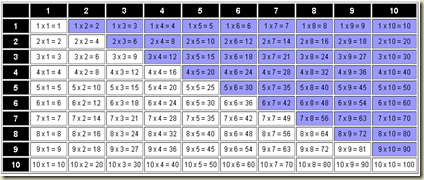
Here is an example that shows that you only need to learn half of the tables.
multiplication grid 001

These are all strategies for students to help them in math. Each student learns differently and each student can use or make aids that will help them learn best.

Teachers need to be able to find these strategies for each student. They also need to involve the students in finding these strategies, these ways to make sense of math.

Sal Kahn,The Kahn Academy, mentioned in an earlier post, agrees that students need to take time to understand what this learning concept means, not just do a problem and get the right answer. Once true understanding of the concept is earned, then the next step in math is easier, etc.

HOW do you make sure EACH of your students understands the concept? Leave a comment.

[As always, in my author quotes, the underlines, color changes, and bold type is mine, not the author’s!]

Monday, June 28, 2010

Thanks to my PLN … Kahn Academy … UTube UNIVERSITY … IMHO

I am SO LUCKY!

I have a great PLN (Personal Learning Network).

I have a huge list of blogs that I read.

Sometimes I read every single word; sometimes I scan the posts; sometimes, I feel like  I am way behind in reading all the posts and so I (Gasp!) say I have read them (and click them READ) just to get my number of unread posts lower!

There, I have admitted it. It feels so good!

Dean Shareski,of Ideas and Thoughts blog, is someone who I have followed his blog posts for some time, and even followed him on Twitter (although I have to admit – Gasp! – that I am NOT a twitter guru or complete convert!)

Today I was catching up on some blog posts from those many blogs on my blogroll, and suddenly, I saw this post: The Kahn Academy.

I wasn’t sure I was going to watch the video, but something in the blog post piqued my curiosity. So I watched. And if you try it, you, too, should be glad you did.

Sal has such an unassuming quality to his manner of speaking that you immediately feel you know him, you like him, and you want to listen to him. These are the reasons his Kahn Academy is so successful and so valuable!

Thank you Sal!

(You see, I can call you by your first name because I feel like you are already my friend, even though we have never met, talked, or seen each other!)

Watch the video and then go on to attend the Kahn Academy and learn things you never thought you would ever understand!

Sal Khan at Gel 2010 (founder, the Khan Academy) from Gel Conference on Vimeo.

Technology Directors/Administrators…What?

Once again, I found a wonderful blog post on Scott McLeod’s blog Dangerously Irrelevant.

It was titled Education needs geeks, but we need a special kind of geek who is one of us.

I cheer on this guest blogger, previously a classroom teacher, Don Watkins, who is now turned into a self-taught (mostly)Technology Guru.

“I read a web posting about replacing your technology coordinator/director with a building administrator.”

Don Watkins does not agree with this idea.

I loved his statement…

“My efforts have always been to knock down walls and to build bridges to places of opportunity for our students, our faculty, our administration and our community. I see my role and those of my fellow technology directors and now technology integrators, curriculum directors, curriculum specialists as people who can and do encourage innovation. We owe this to our various constituencies. We do not serve them well when we accept the status quo. When someone tells me that this or that can't be done I make it my business to prove them wrong.

Yes…that is my philosophy too ... When someone tells me that this or that can't be done I make it my business to prove them wrong.

My corollary is that I will not allow the computer to win.

My students and fellow teachers know this about me.  I may not end up finding the most direct or the “right” way to get it done, but I WILL get it done. The computer is NOT smarter than a human brain with creativity!

We need more people with this CAN DO attitude. We need to teach our students this CAN DO attitude. Imagine where the world would be if everyone had a CAN DO attitude!

[As always, in my author quotes, the underlines, color changes, and bold type is mine, not the author’s.  I do this so often, I should probably put a disclaimer to this effect at the bottom of every blog!]

Terminator for Schools…

I love this video and all school PTAs and parents and teachers will love it as well.

Something has to be done. We need to use our educational money wisely…but we need to get our priorities straight as well.

Many thanks to Scott Mcleod's blog Dangerously Irrelevant.

Sunday, June 27, 2010

Educational Change

Over these summer months, we all need to reflect on our teaching in order to prepare for the next year of teaching. This video from Richard Bryne's Free Tech for Teachers should get your mind moving!

Technorati Tags: ,,

Teacher Appreciation

I found this song about Teacher Appreciation on Paul Blogush’s blog and thought others would enjoy it.

Most teachers, the good ones, do work hard and care…

THANKS to all of you!

Monday, May 17, 2010

The Power of UTube

Wesley Fryer is one of my favorite bloggers to read.

I remember when his daughter posted a video on UTube about her comments on the inaugural speech made by President Obama.  Wesley mentioned the reaction and the “fame” created by that posting.

His blog post is quite a good piece of writing and shows his concern for young Greyson. He gives a “lesson” to Greyson and his family about the internet and the pros and cons of notoriety. All students should learn this.

This is an excellent opportunity for those in education, and especially those in technology and education, to step up to the plate and teach the students we have influence over about these situations.

Learning at this moment when the “fame” is there is VERY IMPORTANT!

From a church talent show to the Ellen DeGeneres Show: YouTube fame for an Edmond 6th grader: Watch it and enjoy.

Here is his interview and performance on the Ellen DeGeneres show:

This is the world our students live in on a daily basis.  Technology is out there everywhere.

I noticed that in the interview Greyson said he got a text from his mom that said to call her.  He was able to accept that text and then excuse himself from the classroom, as he says, and call his mom from school, in the hallway outside his classroom. Obviously his school does not have a problem with cell phones and their use during the school day.

I would like to learn more about what school he attends and what their technology experiences are for all the students in the school.

Then, add to the technological experience that Gaga is on the phone  talking with Ellen and Greyson on live TV. The only thing that could have been better is that there would have been video of her side of the conversation.   Doesn’t she have Skype?

Teachers, technology experts, and interested learners, what lessons can you make from this opportune moment?

Leave a comment… What will you do or how will you use this as a learning experience for your students?

Tuesday, April 6, 2010

Can Duct Tape Fix Everything?

This is an excellent piece of writing (even though I have only heard it, not read it.)

It is also quite a commentary on our society today.

Young girls and their body image….

It is so sad to hear what this girl did, but so wonderful to hear that she learned a mighty good lesson from her experience.
Hopefully young girls will have confidence in themselves so they don’t follow  her unhappy experience.

This video came from the blog post at Stepping Outside of My Writing Comfort Zone.

As teachers, a mothers, and role models, women of these times must stand up and create positive confident young girls.

How do you as a teacher promote positive, confident, secure young women?