Saturday, February 4, 2012
PHOTO PEACH
I found it by following another teacher blog
that had a great slide show
to help students learn
the differences between circles and spheres.
I signed up quickly, downloaded a few pictures
and immediately made a slideshow.
I would like to spend more time with it.
How would you use this site?
Sunday, June 27, 2010
Educational Change
Over these summer months, we all need to reflect on our teaching in order to prepare for the next year of teaching. This video from Richard Bryne's Free Tech for Teachers should get your mind moving!
Monday, May 17, 2010
The Power of UTube
Wesley Fryer is one of my favorite bloggers to read.
I remember when his daughter posted a video on UTube about her comments on the inaugural speech made by President Obama. Wesley mentioned the reaction and the “fame” created by that posting.
His blog post is quite a good piece of writing and shows his concern for young Greyson. He gives a “lesson” to Greyson and his family about the internet and the pros and cons of notoriety. All students should learn this.
This is an excellent opportunity for those in education, and especially those in technology and education, to step up to the plate and teach the students we have influence over about these situations.
Learning at this moment when the “fame” is there is VERY IMPORTANT!
From a church talent show to the Ellen DeGeneres Show: YouTube fame for an Edmond 6th grader: Watch it and enjoy.
Here is his interview and performance on the Ellen DeGeneres show:
This is the world our students live in on a daily basis. Technology is out there everywhere.
I noticed that in the interview Greyson said he got a text from his mom that said to call her. He was able to accept that text and then excuse himself from the classroom, as he says, and call his mom from school, in the hallway outside his classroom. Obviously his school does not have a problem with cell phones and their use during the school day.
I would like to learn more about what school he attends and what their technology experiences are for all the students in the school.
Then, add to the technological experience that Gaga is on the phone talking with Ellen and Greyson on live TV. The only thing that could have been better is that there would have been video of her side of the conversation. Doesn’t she have Skype?
Teachers, technology experts, and interested learners, what lessons can you make from this opportune moment?
Leave a comment… What will you do or how will you use this as a learning experience for your students?
Tuesday, April 6, 2010
Tech for Tech’s sake… NO WAY!
The quote below is from Jen W’s blog post. You should read her entire post.
“Chris Lehmann’s quote of “Technology must be like oxygen: ubiquitous, necessary, and invisible.”
But it seems, for many years, that we created a separate distinction, a specialness, a uniqueness towards Tech that might have been what is causing the separation now of acceptance, use, and comfortableness.”
Do you use Tech in your classroom? Why do you use it?
Do you use it for Tech’s sake or because it is the best way to present the material and the best way to engage the class?
How are you using TECHNOLOGY…AND WHY?
Tuesday, October 27, 2009
Technology advances – In time for Christmas?
What do you think?
Sunday, September 13, 2009
GLOGSTER.com …POSTERS here we come!
One of my Diigo groups posted this bookmark and I decided to try it out!
Glogster is a poster making application. I only made one (see below) but it was a lot of fun. I know you can import photos, probably drawings too, add text to them, save them, and also you can publish them to the web if you want or keep them private. I could embed the code for this one into my blog as well.
![]()
I didn’t quite like the way my text laid out on the speech bubble, but perhaps I could have played around with it a little more. I am not sure if there were alignment adjustments available. I know there were font size and color adjustments. I think the number of fonts is limited.
Overall, for a free tool, I think it is worth a project or two. Besides if the kids like it, they can use it also on their own time and perfect their technology skills!
I always love it when a student takes something we use/do in class and then goes home or in study hall extends the lesson further by using it for their own purposes! Authentic learning!
What fun, yet educational tools do you introduce to your students?
PowerPoint into AuthorSTREAM
I have been playing with one of my PowerPoint presentations ever since. My presentation had audio on each slide that the student was able to click on to listen. That way the student could listen to the audio on a page as many times as necessary for that student to understand what was being learned.
Either my original audio was VERY POOR quality (which it may well have been) or the click as you go audio did not translate to this platform. Thus, I spent a little time re-recording the audio in one fell swoop in a higher audio quality (which took up more space), but the sound carried through to the Authorstream platform. It is not click as you go for either the slide movement or the sound, but it is adequately slow speed for a young learner, I believe.
Here’s the actual comment back to me:
With your strong interest in Technology, I recommend you take a look at Wiziq's virtual classroom and authorstream's power point presentation platform. Both are web based platforms, have a bunch of features and free basic service.I have not yet had a chance to try the other product he mentions. Another day, more fun!
How could you use this platform to engage your students? If your students are old enough and savvy enough, how could they use these technologies?
Saturday, September 12, 2009
PLNs = Personal Learning Networks
Jeremy Biddle, jbiddle, over at Lutheran Educators wrote a post about PLNs - Personal Learning Networks. He created a VoiceThread video to explain it.
http://voicethread.com/share/603588/
Everyone should have one. Most of us have started ours already, but may not have realized it. Now we just have to constantly improve it, add to it, and learn from it.
Who is in your PLN?
How do you increase your PLN?
Happy Learning!
Flickr
http://www.flickr.com/search/?q=creative+commons

http://www.flickr.com/ has a selection of photos that are creative commons photos.
There are really some striking photos in the collection. When you need just the right image and don’t know where to find it, try FLICKR – Creative Commons images. You can right click on these photos and go to “COPY with url” and the information regarding that photo will be added to wherever you are going to place the photo. This is most helpful to teach students the importance of giving credit where credit is due, even if it is allowed to be used. This picture above was from Everyone’s photos with the description Creative Commons.
ALOE BLOSSOMS MACRO (CREATIVE COMMONS PROJECT)http://www.flickr.com/photos/grope4mac/3547437152
There is also a group called Flickr- Creative Commons- Free Pictures. The photo below was from this group.
http://www.flickr.com/photos/ryall/219441351/in/pool-creative_commons-_free_pictures
http://www.flickr.com/photos/mikebaird/2960091638
The picture above is from the collection Flickriver - Most interesting photos from Creative Commons- Free Pictures pool.
With this photo I had a little bit more trouble getting it inserted into my blog. I am not sure why, but am glad it finally worked.
So make use of appropriate photos and be sure to add the appropriate information regarding copyright.
And teach your students to do the same!
Sunday, August 16, 2009
Challenging their Professional Identity
Wesley Fryer, of Moving @ the Speed of Creativity, is one of my favorite blogsters to read. He always has interesting information, ideas, and insights. I like how he also involves his children and their technology activities, sometimes, in his blogs. He seems like such a kind, generous, mild mannered person and then suddenly…
He makes some VERY CHALLENGING (but true!) STATEMENTS:
Wesley says, “To ask an educator used to lecturing every day to give it up for vodcasting, and instead to both craft and lead highly-interactive, engaging face-to-face discussions with students is tantamount to challenging their professional identity and raison d’être.”
Read the whole blog here. He started the whole story with talk about the “Teaching Naked” controversial comment/title in an article about Dr. José A. Bowen of Southern Methodist University.
Because so many teachers of today are the BABY BOOMERS, who are getting ready to retire, as soon as their teacher pensions will allow them to retire (in this economy), there is little (if none) desire to “re-work” lectures and lesson plans by MANY teachers, but this is not everyone in the profession.
Now I have to qualify myself here. I, too, am a BABY BOOMER, who currently is out of the classroom. (I thought I’d retire and then along came the recession and all of its negative impact on my financial security!)
But I am trying to get back into teaching in the classroom because… I WANT to do this type of teaching. I personally am a lifelong learner plus technology and collaborative learning are exciting prospects for me.
True, I am at the elementary level, not high school and college, but the statement above by Wesley Fryer is still pertinent in the elementary education classroom as well.
I also have another question that may or may not be related to this whole topic. You decide.
Are we teaching the future teachers how to teach in this “new” manner or are they just learning the “same old ways” we BABY BOOMERS were taught in the late 60’s and 70s?
Tell me what you think. And if you think we are not teaching them in the “new” manner, what needs to be done? What can we do as leaders?
[As always, in my author quotes, the underlines, color changes, and bold type is mine, not the author’s. I do this so often, I should probably put a disclaimer to this effect at the bottom of every blog!]
Thursday, August 13, 2009
FREE in a digital society… How does one earn money?
I have been wondering this same thing for many days, weeks, months.
In a FREE digital society, how does one earn money?
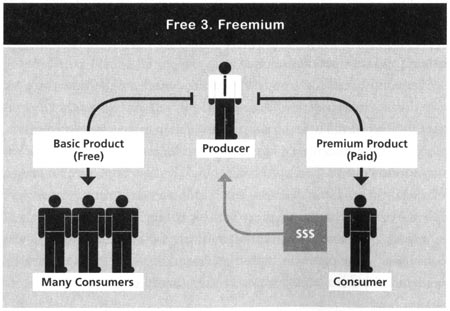
I heard about the figure and description (below) in a blog written by Kevin Kelly. He has an uberblog combining all of his blogs together, but this is from his blog called Cool Tools.
The figure and quote below is from a book written by Chris Anderson, Free- The Future of a Radical Price.
[As always, the underlines, color changes, and bold type is mine, not the author’s. I do this so often, I should probably put a disclaimer to this effect at the bottom of every blog!]

Chris Anderson says in Free- The Future of a Radical Price, “In Denmark, a gym offers a membership program where you pay nothing as long as you show up at least once a week. But miss a week and you have to pay full price for the month. The psychology is brilliant. When you go every week, you feel great about yourself and the gym. But eventually you'll get busy and miss a week. You'll pay, but you'll blame yourself alone. Unlike the usual situation where you pay for a gym you're not going to, your instinct is not to cancel your membership; instead it's to redouble your commitment.”
Kevin Kelly of Cool Tools blog says, “Free is tricky. Free is great for consumers but difficult for business and creators. It is becoming a serious economic force (thanks to digital technologies and automation) but no one is really sure how to use free to, well, make money.”
This reminds me of a situation I recently found myself in.
I read many blogs. I enjoy reading them. I read from a variety of blogs, although most of them have an education/technology bias. One blog that is not in that category is about Marriage. It is a good blog with lots of ideas and helpful comments, stimulating ideas!
Recently I read this Marriage blog and just about deleted it from my Reader. I was furious!
I even wrote a comment! I hardly ever, almost never, make a comment. I might write about what I read in other people’s blogs in my blog, as a way to take the thoughts through my mind for processing. I might occasionally say, “Hey, good blog!” but rarely do I make a negative comment. Actually, I think this was the first!
This blog asked for readers to make a donation if they felt the blog was helpful. Say $25. Say only this year while I am trying to make my change from earning a living elsewhere to earning it with this blog. Say maybe only once every year!
So far, in the comments of others, only 1 other person agreed with me.
Everyone else said,
“Good Luck with the change.”
“Hope this leap of faith works out for you!”
“When I can, I will send you money, but just can’t now, not today!”
I would like to know what others feel about this.
Do you expect to be solicited by the author of the blogs you read?
I am not talking about a blog author who wrote a book and promotes it on his blog, or who provides seminars or presentations and promotes them on his blog, or offers to consult with you privately about what he can do for you personally on his blog. All of these are legitimate to me. If you want that extra special piece of attention/help, PAY FOR IT! That is fine. It is OK to advertise for that. Those interested will click on your link! Those not interested, will just continue reading.
If you don’t want your blog to be free and open, then don’t put it on the open internet. Make it by registration only after a fee has been paid!
Am I too upset by this?
Recently, I even looked at the tab on Blogger where it says monetize. I didn’t go very far, but wondered if this was the “way” to earn my living on the web!
I know several of the blogs I read do place ads on their blogs, and earn some small amount of money when readers click on these advertisements.
I don’t criticize those who do this. (I am not sure, but I don’t think they earn very much by doing this; maybe only enough to pay for the yearly cost of the site maintenance if their blog is posted on a paying site.)
So far, I decided it was not for me. I didn’t feel that my blog had a big enough readership (if any readership) and I didn’t feel that my thoughts were earth shattering. Most of what I post is a re-thinking of what I have read in other places - a directing of others to a good read.
In spite of all this, I do have a desire to make a living in a way that feeds my passions – education, technology, helping others, working with students, education, learning.
I had also thought that somehow I could make this living with my passions on the internet, but in education nearly everything is open source, free.
I’m still reading, thinking, learning, and imagining. Maybe someday, I will figure it all out. In the meantime, I am enjoying the journey! (But not making any money!)
Ask Sir Ken Robinson anything -- and he answers @ TED
TED asked for questions for Sir Ken Robinson and then shared his answers. It is a marvelous dialogue and very typical Ken Robinson.
Don’t you just love listening to him? Don’t you wish he had been your teacher in grade school? OR at least Ken Robinson had taught your teacher before she became your teacher in grade school, high school, or college?
Everyone really needs to read the entire dialogue, but I will share a few things (It turned into more than a few) I gleaned from it.
(Please note that the underlines (or color emphasis) are all mine, not Sir Ken Robinson’s.)
While you read my summary and highlights below, think about Bloom’s Taxonomy…
1) HOW can we OVERHAUL public education and nurture creativity?
“creativity isn't a specific activity;”
“There are skills of creative thinking that can be taught.”
He says, in education, in relation to the lack of creativity, there are 3 areas that need to be considered: 1) curriculum, 2) pedagogy (teaching), and 3) assessment.
2) Today there is overspecialization and compartmentalization of subjects in school; there needs to be more balance and inter-relatedness for creativity to thrive. We should not lose sight of the larger picture.
“So this capacity for imagination, to me, is absolutely at the heart of this whole argument…Creativity is putting your imagination to work and it's produced the most extraordinary results in human culture...it is really the foundation of human culture…it's generated multiple ways of looking at the world, multiple ways of seeing it, multiple ways of thinking about it.”
3) What is a good method of assessment?
“I think it's seeing connections rather than differences which is the heart, I believe, of human progress.”
“…an assessment is always two things. It has a description implied and a comparison.”
“I think the problem with most standardized tests or graded tests or lettered sort of assessments is that they're often very heavy on comparison and very light on description.”
“…And it's really what people can do, and what they're interested in, and what they're capable of that is of most importance in education.”
“So, if assessment is textured and finely-grained, and is supportive and diagnostic, I'm all for it. If it's coarse and simplistic and judgmental and uninformative, then it seems to me always to be negative and have the wrong sort of effects in education.”
4) Where is the place for technology in education?
Technology is important in its own place.
“…I really do think that we have not yet properly begun to exploit the real benefits and potential of information technology in education. My big interest is in how you personalize education and how you customize it, rather than how you standardize it and make it irrelevant to local needs. And one of the ways we do it, I'm sure, is by making much more imaginative and creative use of information technology.
But technology alone will not educate the whole person.
“There are things that you can only really learn by being in the room with people. There are things you can only really learn by getting up and doing them. Not simulating them, but by being outdoors and doing it. By being in your body. By exercising your feelings and recognizing you are not just intellectual and chemalogical* animals. We are sentient, feeling beings who need social contact.”
5) There are “so many individual teachers and librarians out there who GET IT, who want to help their students stop "playing school" and start having authentic learning experiences. How do they build critical mass to change our bureaucratic, cookie-cutter approach to educating children?” & 6) How do I personally help make the change?
Ken Robinson answers: “The real place to focus, initially, is on the work you do yourself. I'm always keen to say this: Education doesn't happen in the committee rooms of Washington, or London, or Paris or Berlin. It doesn't happen in government buildings. It happens in the minds of students and learners. It happens in the classroom.”
“looking at what you can do in your sphere.”
7) What do you think about online/distance learning?
“there's a massive potential that we haven't yet fully tapped into. …we now have the ability to put the best thinking, materials, pedagogy, resources in front of everybody. … a massive opportunity to -- not to replace what they do, not to replace their own teachers and curriculum, but to enrich and enhance it.
8) What do you think of the Summerhill School in the UK?
This school sound to me like it is based on the Montessori philosophy of education, but in an older age group of children.
“They're based on the principle that students, if they're given freedom and responsibility, will rise to it. It won't dissolve into anarchy. It will resolve into something much more productive than people think. The kids have much more moral judgment, much more self-determination, much more responsibility than people would believe, when they're given the opportunity to exercise them.”
“the only way you get schools to improve is by personalizing to these children, these parents, this community, this place.”
9) Another question was from a teacher about what can I concretely do right now? Of the 3 components to education mentioned above, Sir Ken Robinson says Pedagogy is the most important.
“If you want to promote creativity, you need, firstly, to stimulate kids minds with puzzles and questions which will intrigue them.”
"teaching creatively": teachers finding interesting ways into material. Presenting unusual points of entry or interesting angles or perspectives, and enjoying the process of finding them.
"teaching for creativity": creating conditions in classrooms where kids are encouraged to think creatively and imaginatively. Giving them stimulating things to work on. Ideas that will open their mind up. Information they've never encountered. Puzzles that will intrigue them. So you might think of that as stimulating the imagination, setting problems.
- asking open questions
“One task [of} being creative is to hypothesize and think of possibilities and look at alternatives ideas -- to speculate. To be imaginative. But an equally important part for every creative process is to act critically on the ideas you're coming up with. To evaluate them. That's why I define creativity, in the TEDTalk, as the process of having original ideas that have value. You have to figure out which ideas are good and bad. Which work and which don't. Which are worthwhile and which ones are not. Then, of course, it raises the old question of whose criteria you're using and whose values you're operating, and that's a part of the conversation. Being creative isn't just about blowing off new ideas. It's about critical judgment, as well....”
“…group work. An awful lot of creative work doesn't happen individually. It happens with people interacting with other people. The most powerful engines of creative thinking are groups. And the reason that's true is because a great group models the human mind: it's diverse, it's dynamic, it's distinctive. So, knowing how to form groups, how to get groups to work, how long to leave them doing it, is a core skill of good teachers.”
“So I think its three things: it's stimulating imagination, it's telling them problems with open questions, and knowing how to organize groups. And I think in there are the answers to things we can all start doing tomorrow.“
10) How do I get into my “element”, referring to Ken Robinson’s new book The Element?
Ken Robinson says, “…look outwardly… try things …Expose yourself to possibilities. See what begins to chime with you. My point about being in the element is some people make a living doing it, ... it's about finding your own personal element. And the more people are able to do that, the more enriched their lives become, and the more enriched the lives are of those people who are in contact with them.
It's something that we all should do, and something that we all can do.”
If any of you are still here reading after this VERY LONG POST, What do you think?
How does Sir Ken Robinson energize you and your classroom teaching?
AND, are you in your ELEMENT?
I think great teachers are in their ELEMENT.
What do you think?
Friday, July 31, 2009
Teaching Naked... without Technology?
I have used more quotes in this actual blog than I ever have used before in any blog post. Hopefully not too many, and hopefully my multitude of quotes will pique your interest to delve into the issue more deeply and view the actual posts that I am mentioning and others out there on the internet.
The "Teaching Naked" article basically says that the time spent in class should be used for discussion, problem solving and extension of learning, rather than to lecture and disperse information. Students can "read" that information outside the classroom scene and come to class ready to "debate" the issues, to extend the learning, to apply the knowledge, to progress.
Mr. Jose Bowen is NOT against technology. Listen to the podcast along with the article in Higher Education Chronicle for his thought process.
The article in the Chronicle of Higher Education notes that "...students, some of whom have groused about taking a more active role during those 50-minute class periods." This comment implies that there are current college students learning/desiring to learn in a 19th Century model.
Today's college students are expecting 19th Century Teaching. They want to "coast" along with the "regurgitate the text" model. They are upset that they might have to THINK. Perhaps it will take a few years for the "digital natives" to arrive at college.
...says Mr. Heffernan: "Students have been socialized to view the educational process as essentially passive. The only way we're going to stop that is by radically refiguring the classroom in precisely the way José wants to do it. ....Introduce issues of debate within the discipline and get the students to weigh in based on the knowledge they have from those lecture podcasts, Mr. Bowen says."
As Academic Hack states "...but that’s the point, to make them uncomfortable, to challenge them to learn better."
Critical thinking and application of knowledge is where REAL learning takes place. As K-12 21st Century teachers, we must teach students with higher order thinking including starting this teaching at the elementary school level.
A great deal of valid information and dialogue on this topic also comes from the Comments Section:
"...most of the old ways of teaching are predicated on a scarcity of knowledge, the idea that an expert can stand at the front of the classroom and disseminate information which the students soak up, because this is the best way to learn. I think technology renders that model pointless. And I think this is true across disciplines, that all disciplines will have to think/rethink how they use technology to teach."
"I am not saying every class should use every bit of tech, but what I am saying is that every class needs to recognize that the digital network fundamentally transforms the way we share, produce, and archive knowledge, and to treat it as if it has not (to teach in the old factory/industrial centered ways) guarantees our irrelevance and does a disservice to our students. The digital is not something that is supplemental, something that can be merely, tacked on, added on to the curriculum, it is a fundamental shift in the nature of knowledge."
"...a pedagogy of participation and collaboration. The use of digital technology, whether wiki or blog or whatever, just offers more options to extend this model.
The idea is NOT to eliminate technology from teaching. It is to use the correct technology at the correct time to enhance the learning. Each situation is different. There are many different technologies to choose from.
"The issue is not technology but using the technology well to teach our students," says Academic Hack. "Teaching without digital technology is an irresponsible pedagogy. ...Eliminating technology produces not the affect of a more engaged literate student populous, rather it produces the reverse, an ill informed, uncritical, unengaged student populous who will become at the very best passive consumers of the technology being resisted, and at the worst its willing victims."
Teachers must prepare students for their future which is DIGITAL. Students need to be fluent in using digital technology and savvy enough to understand when it is proper to use it, when not to use it, and HOW to use it effectively and appropriately.
This teaching BEGINS in the elementary school curriculum. Then we truly will have DIGITAL NATIVES - graduates of repsonsible 21st Century Learning.
What are your thoughts on this?
How do you see elementary teaching to prepare digital natives for their roles in the lives of their futures?
Tuesday, June 30, 2009
If You Give a Teacher a Mouse...
Friday, December 12, 2008
Class, as they say, is dismissed…but certainly not over.
Check out many of the posts at Technology in the Middle to learn lots more.
Friday, November 14, 2008
GaETC: School Change and Technology
We need to be careful to NOT confuse the TOOLS with the PEDAGOGY.
It is easy when you are a techno geek like myself, to get caught up in the tools, but the goal is to make LIFELONG LEARNERS out of ALL OF US! (including the teachers!)
Monday, September 15, 2008
COMPETITION....Technology
This was posted on the Abilene, Kansas High School Dialogue Buzz website (Courtesy of Kansas High School Dialog Buzz website, via Rae Niles) It was an anonymous post, but VERY powerful. Feel free to share this with educators, parents and stakeholders about the power of the seamless use of technology. What do you think? Is there another side to this competition scenario?
Let’s have a little competition at school and get ready for the future.
I will use a laptop and you will use paper and pencil. Are you ready…?
I will access up-to-date information - you have a textbook that is 5 years old.
I will immediately know when I misspell a word – you have to wait until it’s graded.
I will learn how to care for technology by using it – you will read about it.
I will see math problems in 3D – you will do the odd problems.
I will create artwork and poetry and share it with the world – you will share yours with the class.
I will have 24/7 access – you have the entire class period.
I will access the most dynamic information – yours will be printed and photocopied.
I will communicate with leaders and experts using email – you will wait for Friday’s speaker.
I will select my learning style – you will use the teacher’s favorite learning style.
I will collaborate with my peers from around the world – you will collaborate with peers in your classroom.
I will take my learning as far as I want – you must wait for the rest of the class.
The cost of a laptop per year? - $250
The cost of teacher and student training? – Expensive
The cost of well educated US citizens and workforce? - Priceless
Doug Johnson on his Blue Skunk blog added the teacher's perspective to this competition. Check it out here
Saturday, July 5, 2008
Love to Learn
I am especially enamored with technology, but I love to make things easier in life and to help others learn. Technology can help with this.
I also enjoy the community that can be found via technology. You can learn and find out about anything. There are so many people willing to help you. They don't really KNOW you, but they want to help.
I can easily get lost in the web. There is so much there and I find so much of it interesting. There is never enough time to search and read, and do all that I want to do. AND I AM "RETIRED."
I guess I need to get a job to channel some of this energy and enthusiasm.
The big question is WHAT JOB?
I love my flexibility. I love working with people and technology. I love to help people.
I will continue to ponder this as I enjoy "surfing the web," meeting new friends, and learning.
Tuesday, June 10, 2008
MY TECH - Getting even better
I joined Live Journal http://www.livejournal.com/ earlier today and joined a group called computer help; they were able to solve 2-3 COMPUTER problems that I have had since Christmas! I feel soooo good about all this. This Christmas present (COMPUTER FIX) was leftover from last Christmas and I just found it this year! LOL
I also made a semi-choice to perhaps (am I a little wishy-washy about this?) go back to school for my Masters even at this OLD AGE!
I already have a masters in Education with a concentration in Reading and Language Arts, but this would be in Technology.
Probably no one will ever hire an OLD LADY, but I will enjoy the time I spend learning and using what I learn. I DO LOVE TO LEARN!
Perhaps SOMEONE out there will see my abilities and want to use them! Then I can have my dream job again!
Monday, June 9, 2008
Combine vocation and avocation
My object in living is to unite
My avocation and my vocation
As my two eyes make one in sight.
Only where love and need are one,
And the work is play for mortal stakes,
Is the deed ever really done
For Heaven and the future’s sakes.
That's what I want to do, combine my love of technology and education into a vocation as well.
Any ideas?

Digg/fivbert
Flickr/fivbert
Myspace/fivbert
Facebook/fivbert
Twitter/fivbert
YouTube/fivbert
Del.icio.us/fivbert
Wikipedia/fivbert
GMail/fivbert
Technorati/fivbert
Blog/fivbert