Wednesday, September 23, 2009

Teaching vs. Learning

I just read a blog post at Modite by Rebecca Thorman entitled Become an expert quickly.

Rebecca Thorman supports my philosophy about Learning…

Teaching something gels the concepts in your brain so much better than just hearing about it or doing it.

Teaching makes you think about the whole idea and synthesize it, make it understandable to others. Teaching what you have learned is the best way to know what you learned. 

Rebecca says
So tell me, how well can you explain what you do? How well do you understand your passion? Could you teach someone else to do it?
Doing is just not enough. Rebecca says
When you do something like send a pitch, for example, you’re learning. You’re testing your ideas and theories through the reaction you receive, the resulting outcome. In this paradigm, it’s okay to fail, you discover through trial and error, and through persistence and hard work, you win.
Teaching makes you think through what you think you know. In explaining and teaching the concept to someone else, you have to understand all aspects of the subject matter, from many different angles.

Rebecca agrees that there is a difference between learning and teaching. In learning…
But there’s an entire level of awesomeness missing. And you can only ascend to the next level by then teaching someone what you have learned. Because then you’re testing your values, ideas and theories with another person’s values, ideas and theories. You understand the underlying challenge more by defining it for another. Teaching – good teaching – requires you to exchange knowledge, not simply impart it. Learning is individual. Teaching is collaborative.
So, when you teach something, you get something back that makes you even understand the concepts better. It confirms what you thought you learned - what you thought you knew about the subject OR maybe it confirms that you were wrong and you have to change your knowledge.
Teaching is sharing knowledge, sharing empathy, sharing ideas. It’s pushing you to understand with entirely different lenses. Just like your body needs both cardio and strength training, your mind needs both learning and teaching.
Teaching is the definitive learning experience. And it’s the quickest way to expertise.

How do you provide experiences for your students to not only Learn, but teach what they learn?
Share your ideas.

[As always, in my author quotes, the underlines, color changes, and bold type is mine, not the author’s!]

Sunday, September 20, 2009

Art online

I read a blog post at Teachers Love SmartBoards about SMARTBoards and Creating Original Artwork that mentions an online drawing program in Beta called ArtPad. This can be used on a SmartBoard but also on an individual computer.

I worked with the program and made a drawing, but when I saved the link for my artwork, I could not find it.

You also have the option of e-mailing your drawing to friends. At this point it has not yet been e-mailed to me. I will update if I get it in an e-mail. art pad pic #2

I made a screen shot and copied it into Paint and it is shown here.  When you are on the site, you can have the experience of the drawing from beginning to end replayed.


Below are the links to my drawings:
#1 http://artpad.art.com/?kq14ofy5hng
#2 http://artpad.art.com/?kqaxe31jxncw

Please comment if you can find/see them. Perhaps there is something wrong on my computer. I have been having problems with the Java applets.

If this program works properly, then it would be a fun way, especially for younger students, to make art.

Learner experts or Content experts?

Should teachers be Experts in Knowledge of their Subject Matter or Experts in How to Teach Students?

Most people would agree that there should be some of each type of Expert in every teacher. But the question is which is most important?  Also which is most important at what levels of teaching?

In the past, from my experience, and perhaps from a current perspective of how teachers are taught in college, I surmise the following levels of expertise:

Elementary school teachers are to be knowledgeable in HOW to Teach.  It is thought that the knowledge that elementary teachers are presenting to their students is knowledge that every educated person knows if they have received a college degree.  Thus, more of their time in the teacher education degree in college is spent on teaching methods, or on teaching methods related to specific subjects.

High school teachers have had more emphasis prior to teaching certification on being very knowledgeable in their Subject Matter field of teaching, but not to the degree that they are an expert. They need to know beyond high school knowledge of the subject matter, and probably a thorough college level knowledge of their subject matter, but still not an expert.

In college teaching situations, professors need to be true experts in their fields to be respected and able to present the level of material that is necessary for a college level class. Unfortunately many times in college lower level courses, it is teaching assistants that do most of the “teaching.”

In this current day of Information Overload and Access to Instant Information, is this expertise of knowledge of subject matter as important or more important than knowledge of HOW to TEACH?

Are teachers merely the Information Dispensers, the Information Curators, the Information Inspirers, or the Information Extenders?

(I need to work on that word Extenders.  There is a better word that I am not coming up with at this time. Feel free to comment to me about a better term. Maybe Information Facilitators?)

From Ashley Tan’s blog, Another dot in the blogosphere, he writes about this question in Innovation in educational technology. Ashley says":
Polivka offers some answers to his question. But I think the best one is that teachers often see themselves as content experts instead of learning experts.
    • Education as an industry is full of people who are content experts, and severely lacking people who are learning experts. Or more specifically, learner experts. I don’t mean people who know and adhere to theories about learning. I mean people who really get the whole process, and are passionate about it, from the learner’s perspective. People who love the thrill of learning, the way kids in kindergarten love it, and want everyone to have that sort of joy again. People who want to learn, and want others to learn, and want everyone to apply that learning, with the same exuberance that hobbyists do. What makes learning work and why? What makes learning exciting, interesting, rewarding? We need more people who are experts in those things, because whatever products they create will reflect it.
It’s time to relearn teaching.
Teachers should be facilitators of learning, Information Facilitators, not just Information Dispensers.

How do you make learning fun, exciting, interesting, and rewarding to the learner?

[As always, in my author quotes, the underlines, color changes, and bold type is mine, not the author’s!]

Each one, Teach one

From Each one, teach one by Ashley Tan at his blog Another Dot in the Blososphere.  Ashley says
Karl Kapp shares his thoughts on how students can become better learners. They should teach.

Kapp calls this approach the “each one, teach one” method. Catchy name for something that I am sure progressive educators practice but might not label as such. Perhaps he should trademark it!
I agree that as students learn something, they learn it more clearly when they teach it to someone else. 

Teaching a concept requires students to understand the concept and to formulate how to make someone else understand it.  Now, students may not think about various learner strategies and how to teach all students in the class, but they will be able to reach certain students because they are coming at the learning from a student’s perspective which most of the time a teacher cannot do.  I know many teachers try to get this perspective, but, of course, students are best at this!

How do you allow your students to teach the lesson?

Birds on the Wires Make Music

I found this on  Bird’s eye view a blog post by Ashley Tan at Another dot in the blogosphere.


Birds on the Wires from Jarbas Agnelli on Vimeo.

Looking at something from a little different perspective.

How often do we encourage our students to come up with a different answer to our questions? 

To think about the assignments in a different way than we had ever intended?

What do you do that allows different answers to your questions?

Sunday, September 13, 2009

GLOGSTER.com …POSTERS here we come!

One of my Diigo groups posted this bookmark and I decided to try it out!

Glogster is a poster making application.  I only made one (see below) but it was a lot of fun.  I know you can import photos, probably drawings too, add text to them, save them, and also you can publish them to the web if you want or keep them private. I could embed the code for this one into my blog as well.

I didn’t quite like the way my text laid out on the speech bubble, but perhaps I could have played around with it a little more.  I am not sure if there were alignment adjustments available. I know there were font size and color adjustments. I think the number of fonts is limited.

Overall, for a free tool, I think it is worth a project or two. Besides if the kids like it, they can use it also on their own time and perfect their technology skills!

I always love it when a student takes something we use/do in class and then goes home or in study hall extends the lesson further by using it for their own purposes! Authentic learning!

What fun, yet educational tools do you introduce to your students?

PPT2YOUTUBE.. making a flash movie

If you read yesterday’s post, PowerPoint into AuthorSTREAM, you will know what I am doing here… trying the competition’s way to insert a video into your blog. 

I think that this video might be too big for a blog.  The file is certainly much larger than the AuthorSTREAM file was and certainly bigger than the original PowerPoint File was. This file is 6 min 41 seconds long.

It is the same file that I used yesterday, but I made it into a MP4 file at 640 x 480 with 30 frames per second.  Those are the recommended statistics or parameters to make the best video.

When I inserted it into Windows Live Writer, where I have been composing my blog posts lately, it seemed to take a VERY long time, but perhaps it was being converted into UTube video style.  We will see how long it takes and if it is able to be posted to my blog, or if it will be too large. I think it took about 10 minutes or so to get it formatted into the Live Writer blog composer.

So, if you see a video, it is OK. If you do not see a video, go through to my actual blog if you are in a reader. Sometimes videos, etc. don’t show up in the reader.

I think it is working right, but I wonder when you look at my blog how long it will take to start.

This is so much fun!  You’d think I was a kid in a toy storeI AM!

Lifelong Learner! – that’s me!

PowerPoint into AuthorSTREAM

I made a comment on a NING that I am a member of and someone commented back to me that if I was so “gung-ho” on technology, I should check out the following platform.  So I did. 

I have been playing with one of my PowerPoint presentations ever since.  My presentation had audio on each slide that the student was able to click on to listen. That way the student could listen to the audio on a page as many times as necessary for that student to understand what was being learned. 

Either my original audio was VERY POOR quality (which it may well have been) or the click as you go audio did not translate to this platform.  Thus, I spent a little time re-recording the audio in one fell swoop in a higher audio quality (which took up more space), but the sound carried through to the Authorstream platform. It is not click as you go for either the slide movement or the sound, but it is adequately slow speed for a young learner, I believe.


Here’s the actual comment back to me:
With your strong interest in Technology, I recommend you take a look at Wiziq's virtual classroom and authorstream's power point presentation platform. Both are web based platforms, have a bunch of features and free basic service.
I have not yet had a chance to try the other product he mentions.  Another day, more fun!

How could you use this platform to engage your students? If your students are old enough and savvy enough, how could they use these technologies?

Saturday, September 12, 2009

Just Wash Your Hands

This is a video created by Bill Nye Tells Kids to Wash Their Hands that I found in Richard Byrne’s blog post where he says:
It’s a quick music video reminding kids to wash their hands to prevent the spread of germs.
The video goes nicely with these ten videos that I linked to last week.
The video also goes well with these lesson plans about preventing the spread of germs.
SO….Just Wash Your Hands!
[As always, in my author quotes, the underlines, color changes, and bold type is mine, not the author’s!]

PLNs = Personal Learning Networks

Jeremy Biddle, jbiddle, over at Lutheran Educators wrote a post about PLNs - Personal Learning Networks. He created a VoiceThread video to explain it.

http://voicethread.com/share/603588/

Everyone should have one. Most of us have started ours already, but may not have realized it. Now we just have to constantly improve it, add to it, and learn from it.

Who is in your PLN?

How do you increase your PLN?

Happy Learning!

How we learn… most important

“Our culture lies. They say they want to encourage and reward individuality and creativity, but in practice they try to hammer down the pointy parts, and shame off the different parts.” – Sandra Dodd
Leo Babauta of Zen Habits wrote an interesting post entitled Education Needs to Be Turned on Its Head.
Leo says, and I agree:
What we learn in school isn’t nearly as important as how we learn, because how to learn is the lesson of school.
In other words, find problems that interest you, and figure out how to solve them.
Schools and learning need to be working to teach students how to learn, how to learn independently.  Children Learn What They Live by ~AbadHero888~ [ boy UNO ]

As a parent, my  goal for my children always was to make them independent.  We, as parents, are always teaching our children something new so that they will be able to live on their own without us, their parents.

http://www.flickr.com/photos/tagtagainep19/3764366994

It is the same way with schools and learning. Students need to be prepared for their own lives, their futures, when they have to think on their own, when the teacher is not there dictating what needs to be done or learned and how to do it.
Sometimes, you’ll have to solve problems that aren’t so interesting, just to solve problems that do interest you. That’s OK. That’s how things work.
Link to FUN PICTURES WITH KIDS

And here’s a secret: we already know how to do this. From birth. This method of learning is innate in all of us. It’s built in.

http://www.flickr.com/groups/funpictureswithkids
So let’s allow students to use their natural curiosity to learn the skills they need.

Teachers should be facilitators of learning, not dictators.

How do you facilitate learning in your classroom?


[As always, in my author quotes, the underlines, color changes, and bold type is mine, not the author’s!]

Flickr

Small CC photo below from:
http://www.flickr.com/search/?q=creative+commons
creative commons logo 1 by amanhem
http://www.flickr.com/ has a selection of photos that are creative commons photos.

There are really some striking photos in the collection. When you need just the right image and don’t know where to find it, try FLICKR – Creative Commons images. You can right click on these photos and go to “COPY with url” and the information regarding that photo will be added to wherever you are going to place the photo. This is most helpful to teach students the importance of giving credit where credit is due, even if it is allowed to be used. This picture above was from Everyone’s photos with the description Creative Commons.
ALOE BLOSSOMS MACRO (CREATIVE COMMONS PROJECT) by A Million to One.
ALOE BLOSSOMS MACRO (CREATIVE COMMONS PROJECT)http://www.flickr.com/photos/grope4mac/3547437152

There is also a group called Flickr- Creative Commons- Free Pictures. The photo below was from this group.
Alfred Ruined by Chris Ryall.
http://www.flickr.com/photos/ryall/219441351/in/pool-creative_commons-_free_pictures
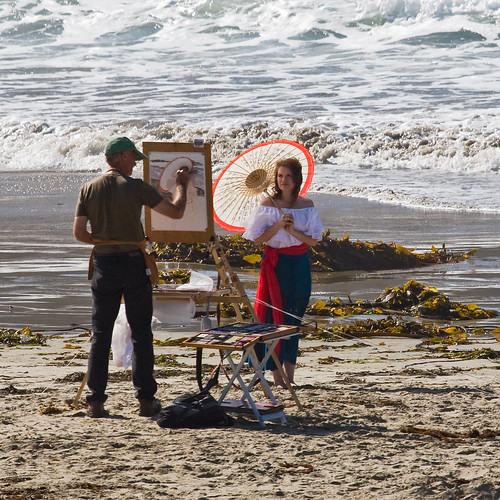
2 of 5 Painter with his beautiful female subject in Spanish dress by mikebaird.
http://www.flickr.com/photos/mikebaird/2960091638
The picture above is from the collection Flickriver - Most interesting photos from Creative Commons- Free Pictures pool.
With this photo I had a little bit more trouble getting it inserted into my blog. I am not sure why, but am glad it finally worked.

So make use of appropriate photos and be sure to add the appropriate information regarding copyright.

And teach your students to do the same!

Monday, September 7, 2009

Student Blogging Guidelines

Many schools in this 21st Century are adding blogging to the writing experiences of their students. It can be an experience that makes students more aware of the global connectedness of the world in this day and age and provide an outlet for their writing spirit. It makes a purpose to their writing, a reason to write so others can understand what you are saying, a reason to use correct spelling, punctuation, and grammar, etc., not just another assignment.

Student Blogging Guidelines by Kim Cofino at Always Learning reminds us of several items to think about before opening up our children to this opportunity on the web. Her school developed these for 3, 4, 5th graders last year and has now posted them for K-12 students as well. They are well worth perusing.
Student Blogging Guidelines
As a student blogger at ISB, you are expected to follow these blogging guidelines below. Use the questions in italics to help you decide what is appropriate to post on your blog.
1. Only post things that you would want everyone (in school, at home, in other countries) to know.
Ask yourself: Is this something I want everyone to see?

2. Do not share personal information.
Ask yourself: Could someone find me (in real life) based on this information?

3. Think before you post.
Ask yourself: What could be the consequences of this post?

4. Know who you’re communicating with.
Ask yourself: Who is going to look at this, and how are they going to interpret my words?

5. Consider your audience and that you’re representing ISB.
Ask yourself: Do I have a good reason/purpose to do this?

6. Know how to give constructive feedback.
Ask yourself: What will I cause by writing this post?

7. Treat other people the way you want to be treated.
Ask yourself: Would I want someone to say this to me?

8. Use appropriate language and proper grammar and spelling.
Ask yourself: Would I want this post to be graded for proper grammar and spelling?

9. Only post information that you can verify is true (no gossiping).
Ask yourself: Is this inappropriate, immature or bullying?

10. Anytime you use media from another source, be sure to properly cite the creator of the original work.
Ask yourself: Who is the original creator of this work?

Commenting Guidelines
As a blogger, you will be commenting on other people’s work regularly. Good comments:
  • are constructive, but not hurtful;
  • consider the author and the purpose of the post;
  • are always related to the content of the post;
  • include personal connections to what the author wrote;
  • answer a question, or add meaningful information to the content topic;
  • follow the writing process. Comments are a published piece of writing.
Even adult bloggers can learn some hints for themselves about how to act when blogging online.

Blogwalker also has some timely Tips for New Bloggers that you also might want to check here.

If you do have a class of bloggers just starting or continuing to develop their blogging skills, please check out this Blogging Challenge by Sue Wyatt. It may be too late to join, but it can still be an excellent opportunity to learn how to comment on someone else’s blog – an important skill.

A teacher might not send her students to this following site because it is more written for adult media consultant bloggers, but the tips included here at  7 Habits of Highly Effective Blogs can be adapted to use for students as well.

I just posted comments to a class of 1st grade bloggers and 5th grade bloggers. The 1st grade bloggers posts were edited by the teacher, as many would not yet be readable, but I can hardly wait for the year to progress to see how the students are learning to write. There will be amazing differences, especially in the 1st grade blogs!

Do you have your own personal blog?

Do you have a professional blog for education?

Do you encourage your students to blog, even if they are in 1st grade?

Do you need someone to read those blogs?

Ask your twitter community. That is how I found out.

Getting to Know Your Students

Matthew Needleman at Creating Lifelong Learners wrote a recent post entitled Back to School Week- It’s a Marathon Not a Sprint.

He writes about how many teachers prepare “Getting to Know You” activities for the first few days/week of school.  He makes the point though that you will need to wait throughout the year, the long haul, to really truly “Get to Know” your students. 

And it is a life long journey.  Sometimes, you see your former students after many years.  You wonder what happened to that “cute little girl” or that “rambunctious little boy”?  You may see them “All Grown Up’” and can see glints of their former selves.  OR they are completely different.

Just remember, you have an influence on their life and you need to be sure that influence is a positive one. One that will help them become “All that they can be!”

A little extra time spent helping them, doing something special for them, making the lesson come alive to them, creating a love of learning can have a lasting effect on them, their self-esteem, and their future.

As Matthew concludes:

So, if you think you’re going to get to know your students during the first day, first week, or even first month of school, remember it’s a marathon and not a sprint and keep yourself open to getting to know who they are all year.  Knowing who they are helps you know how to reach them.  And the ones who are hardest to reach need you the most.

What will you do to get to know your students?

Will you remember them long after they leave your classroom? 

Will you recognize the Person they have become in later years?

What positive effect will they remember from your class?

[As always, in my author quotes, the underlines, color changes, and bold type is mine, not the author’s!]

Photo Effects FUN!

SeaWorld w the rooses effect
This photo was made to look like a Polaroid photo and a caption was added working from the online site 29 Photo Effects and Tools for your Blog and Presentations and Personal Pictures – Online Photo.


http://www.tuxpi.com/

You can even make posters! 

I used this shot of my older daughter Jenny (L) visiting with cousins at SeaWorld this summer.

Students always enjoy making something special when they are working on a project. 

How can you use this in the classroom?

What skills would your students need? 

Please share some.

Saturday, September 5, 2009

How has learning changed? – a nifty picture evaluation

I just “found” Paul Bogush over at Blogush thanks to my friend and PLN member Pat H (aka Loonyhiker) at Successful Teaching

You should all follow Pat. She has lots of knowledge and follows the best people.

Anyways, Paul Bogush shows a nifty picture response to class evaluation. See the picture below.

Notice that the student expects to be able to continue after this year’s class with this newer style of learning.
This “evaluation” is just one example of the innovative and creative examples that Paul shows his students in the classroom. 
His students know that (as he states in his Intro to Class -- First Day Song) you might notice that the teacher is a bit different. These kids feel wanted, accepted, and motivated to learn in more creative methods.

Listen here: First Day Song

Sure he could just be blogging about the best and brightest of his class “teaching” experiences, but I think not.  He is a bit shy to boast (So I’ll do it for him!), but I think he is the kind of teacher I’d want for my own children. (My children are all grown up now, but still…you understand what I mean!)

I’m so glad I “found” him and can’t wait to see what new thoughts and ideas and conversations he comes up with on his blog. It will never be dull over there at Blogush!

What do you do that is unique, welcoming, or allows for individual differences in your classroom to make the students feel accepted?

Tell us and show us.

Thursday, September 3, 2009

Wordle – We Can!

We Can Wordle
Just had to showcase this wonderful Wordle from Kathy Cassidy’s Grade One class blog.

A great use of a Wordle
Every class, every child should be able to make one of these themselves. Think of the self-esteem created here!

Do you know what Wordle is? 

You take some text, whatever words you want to use, (the text from a blog post, the text from the Declaration of Independence, the text from a story a child wrote, or the text from a book, etc.) Then you insert the text into the “Magic Wordle Maker," (click on the link Wordle to get to the website) and Voila! You have a Wordle that makes words that appear most often in the text bigger than words that appear less often.  There are also tricks you can use to add special effects and finagle the way it looks and works!

By the way, did you know that the maker of Wordle, Jonathan Feinberg, listened to educators?  Teachers were cautious using Wordle with students because there are some Wordles that others have made that may not be acceptable to children viewing.  Now when you go to Wordle, you automatically get to the "Create a Wordle" page, not the page that showcases the most recent examples of Wordles that have been made!

How have you used Wordle in your classroom, with your colleagues/teachers, in your blog, in a presentation to other teachers/administrators?

Please share those.

Teacher’s Guide to Web 2.0 at School Illustrated


Sacha Chua is a wonderful blogger, friend, and part of my PLN (Personal Learning Network).  Sacha and I have only met via the internet, but I feel like I “know” her. I feel like she is in “my circle of friends.”  I don’t really remember how I “found” her on the internet.

She is not in education, in the teacher sort of way, but she is an educator by teaching others the things she knows or has learned, and, of course, she’s a lifelong learner, as well.

She works for IBM and works on some stuff that I know nothing about called Drupal and emacs.  She is very smart. a great writer, and a great presenter, plus a cat lover, social connector, gardener, seamstress, and improv wannabe/learner. She has so many interests that it makes me dizzy just thinking of all the areas she dabbles in.  (Many areas are much more than a dabble, believe me!) She’s just an all around great person.

First, let me warn you that Sacha has a way with pictures… bet you thought I was going to say “way with words!”  She has that “way with words,” too, but she uses as few words as necessary and many drawings, simple drawings, handmade drawings, not fancy worked over images. Her few words and simple drawings have a mighty impact.  I guess what she really does is get to the “heart” of things - the meat of the matter.  She always makes an idea seem so easy to learn, as well.

Please enjoy the SlideShare presentation Sacha made for teachers.
When you have a chance, wander over to her blog.  She always has a lot to say.

Now tell me what did Sacha tell you that you didn’t know before?
What did Sacha make you realize you already knew, but just hadn’t realized it yet?
Did Sacha make you  just a little bit more interested in Web 2.0 tools?

Wednesday, September 2, 2009

PROMISES…Dear Teacher

In an earlier post A Letter to the Teachers of My Children by Shelley at Teach Paperless, I made comments regarding a letter from parents to the teachers. Promises
Now here is a poem by Angela Maiers entitled:
Dear Teacher - The PROMISE Poem
PROMISES
by Angela Maiers
Dear Teacher,
Love me,
Make me feel special,
Make me feel included,
Make me feel valued,
Smile for me,
Tell me that you’re happy to see me,
Tell me that you’re happy to teach me,
Tell me that you’re happy I am here.
Involve me,
Tell me about our work together
Tell me how I can be of help and mean it genuinely
Notice me,
See all of me,
See my emotions, my laughter, my curiosity, my anticipation
See my right, and I will work on the “wrongs”
Teach me,
PLEEZE don’t just tell me what you know
Show me what I need to know,
Show me how to do it well
Help Me,
Help me when it gets hard,
Help me persevere,
Help me know it matters
Excite Me,
I came to you in love with learning
Keep me excited!
Show me the fun
Show me your fire and passion
Promise Me,
Promise me that you can.
Promise me that you will.
Promise me that you are ready to
Love me, help me, engage me, excite me, and teach me
I'm Ready
I want to learn.
I want to know.
I want to
be your student
.
I PROMISE
I will return the favor
I will reward you with my attention, my focus, my heart
I will show you what I can do
I will show you who I can be
PROMISE ME?
I know I could link back to her website to see the poem and only quote a few lines here, but I just love seeing it all laid out here together.

Besides, this way I can highlight the words I want to (as my regular readers know!)
Thanks Angela, this poem is a keeper for sure!
Do you write poetry or prose…
     … that tells your students…
         what you expect of them and…
                    what you will give them in return

Please let me see it.
Thanks!
Photo on Flickr by verrosassi4
[As always, in my author quotes, the underlines, color changes, and bold type is mine, not the author’s!]

The Flow of our lives…

The Flow from Journeys by Diane - a retired (just this year!) librarian makes each one of us think about what we are doing, how we are living, and how our teaching is changing.

Photo from Marie Coleman, whose photograph and comments suggested the topic of the Journeys posting.
Diane from Journeys says
To "go with the flow" is generally understood to mean moving in concert with prevailing trends.
How many of us as teachers or education professionals are “going with the flow,” especially in regards to technology and digital pedagogy?
Are we really in favor of technology and digital pedagogy or just following the crowd?
Do we truly believe these tools will increase students’ understanding and abilities?
Or are some of us ignoring these newer strategies and just going with the Old Flow of our teaching profession.  Some of us will soon be retiring; so why bother with changing the flow and learning new techniques and strategies?
We need to take time out of our busy lives to think a little about this.
Are we just going with the flow?
Should we stand up and make a ripple?
Diane remembers how
Senator Robert F. Kennedy described a powerful yet positive current in a speech at the Day of Affirmation, University of Capetown, South Africa:
"Few will have the greatness to bend history itself; but each of us can work to change a small portion of events, and in the total of all those acts will be written the history of this generation...
It is from the numberless diverse acts of courage and belief that human history is shaped. Each time a man (or a woman) stands up for an ideal, or acts to improve the lot of others, or strikes out against injustice, he (or she) sends a tiny ripple of hope, and crossing each other from a million different centers of energy and daring, those ripples build a current which can sweep down the mightiest walls of oppression and resistance."
Diane says..
The flow can be a positive or a negative. How we deal with life's currents is, fundamentally, a very personal decision.
Diane ends her blog post with this quote that reminds us all
“In the long run, we shape our lives, and we shape ourselves. The process never ends until we die. And the choices we make are ultimately our own responsibility.” -Eleanor Roosevelt
Are you “just going with the flow” or “making ripples?”
Tell me what you are doing?
[As always, in my author quotes, the underlines, color changes, and bold type is mine, not the author’s!]

Roads less traveled…Character Development

In an article for Change.org's Education Blog entitled Character Development- Opportunity Costs and Roads Less Traveled by Bruce Smith, he states:

One of the first things you learn studying economics is that you can't have it all. Opportunity costs, they call it: given finite amounts of time and other resources, pursuing any course of action means doing without certain things. English classes typically find this concept in Robert Frost's "The Road Not Taken"..."And sorry I could not travel both/And be one traveler."

Bruce Smith says there are 2 roads for schools to take:

the roads of content and character

Conventional schools devote vast amounts of time to content, to academic knowledge and skills. Everywhere you look, people are declaring what every Nth grader should know. Endless hours are spent drilling

Covering content requires so much time partially due to students' resistance, but also because the amount of information keeps increasing exponentially. Not to mention, what little time isn't spent on instruction is consumed with assessing how well students have ingested the material. In a manner reminiscent of weeds, homework and tests become so prevalent as to choke nearly all the life out of learning.

He continues that this is a

most unfortunate consequence…

this fixation on academics means discounting character development, a truly critical function of education. In most schools, things like integrity, initiative, persistence and responsibility are supposed to develop spontaneously, a happy side effect of regular academic instruction.

Yet character development takes at least as much time as academics, and is too important to simply squeeze in on the side. Acquiring decision-making, problem-solving and interpersonal skills takes practice. Self-discipline, goal-setting, flexibility and resourcefulness are hamstrung when students are busy assimilating knowledge others have deemed important.

Overexposure to content means a relative neglect of character development—but does the opposite hold true?

There will always be gaps in people's learning—always opportunity costs, always roads we cannot take.

The good news is, gaps in knowledge can be filled with relative ease by those of strong character.

The increasing amount of information to be absorbed/learned is overwhelming. No one can know everything they need to know in this day and age. Thus, the internet can be the friend of all, but especially of the student (even the lifelong learner!)

If we teach students a love of learning, a curiosity for learning, and skills for information seeking, their  need for learning will win!

Nashworld wrote on his blog about the importance of play.  He also mentions how the natural curiosity of babies, young learners, allows them to learn many things on their own in their own little worlds.

True, certain opportunities need to be in place, but all babies learn. Some babies learn certain facts and other babies learn other facts depending upon what they have in their environments and what they are allowed to experience, and how they are encouraged. The knowledge they learn does depend on the environment they are put into, the opportunities that they can be exposed to, but they still are learning. (Unfortunately, for some, their experiences may be negative learning experiences depending upon their situations.) 

What do you think is more important…

        … academics or character development?

How do you balance these two skill sets?

[As always, in my author quotes, the underlines, color changes, and bold type is mine, not the author’s!]

Literacy Revolution or More Illiteracy?

Are We Seeing More Illiteracy, Or a Literary Revolution?

from
Change.org's Education Blog by Mike Smith

[Photo credit: Shareski]
Mike Smith wonders if there really is more writing going on than ever before!
I think he has a great point here.
If teachers are using the opportunities the internet and blogging allow, just possibly there is more writing going on today.
I just wrote comments to a class of first grade bloggers.  (You can too… go to Kathy Cassidy’s class blog.)
Now today their writing is not spelled well (or for some spelled at all – the teacher was the editor so we could understand what was said!), but I can’t wait to see their writing as it progresses over the school year. 
These students have an audience and they will have a reason to learn to write --- an audience of more than their parents and their teacher.  As students grow in ability and age their writing will take them many places.
These quotes taken from the blog post at Change.org Education seem to agree with my thoughts:
Clive Thompson discusses a potentially huge paradigm shift, asking whether we're seeing a literary revolution rather than increased illiteracy that's aided by Facebook, texting, and "dehydrated language."

Andrea Lunsford, professor of writing and rhetoric at Stanford, suggests that young people write far more than any previous generation. Having collected and analyzed 15,000 writing samples she concludes "we're in the midst of a literacy revolution the likes of which we haven't seen since Greek civilization."

Literacy is doing more than just grow in one direction: It's exploding and branching off into completely new directions.
What are you doing with your students to encourage more writing? 
How do they like it?
[As always, in my author quotes, the underlines, color changes, and bold type is mine, not the author’s!]